
Vale Mags Webster

Mags Webster, Katanning, Western Australia, September 2024. Photo Tineke Van der Eecken
A very special friend has passed away after a very brief and devastating illness last December. Mags Webster was a kindred soul, astonishing word smith, a friend and collaborating artist, and a mentor. She performed at my first solo exhibition at Monart Gallery in Dalkeith (WA) in 2004, and we followed each others’ creative journeys, joining hands when we could around poetry, writing, book launches and jewellery events. She was our guest poet at Poetry d’Amour when she returned heartbroken from Hong Kong, at a time my relationship also broke down. It was so good to see her glowing and in love with Alessandro years later at the launch of my poetry book, and she chose to read ‘Val di Mello’. In 2024 Mags wrote the essay for my exhibition ‘Concurrencies’, and afterwards guided me through writing a practice-led research article I was underconfident about. “It will write itself, you’ll see.”
These photos were taken when we travelled for an ART ON THE MOVE panel in Katanning in September 2024, and Mags was a panelist. We had such fun and rich conversations during the panel, and as a team delivering this, that we decided to keep our conversation going. Our last luncheon was in October 2025 at our place in Fremantle.
I have always been in awe about Mags Webster’s artistry as a writer, and I love how broad an English language she drew from when composing poems. I made reference to this in one of my early poems, On Language, written in 2011 after reading Mags’ poetry book ‘The weather of tongues’ (Sunline Press, 2011).
In honour of Mags’ wisdom and keen eye for art and the art of words, I would like to take you to the panel discussion we had in Katanning. I sincerely thank ART ON THE MOVE for making this panel possible, and for recording the event and making it available for public viewing on their site.
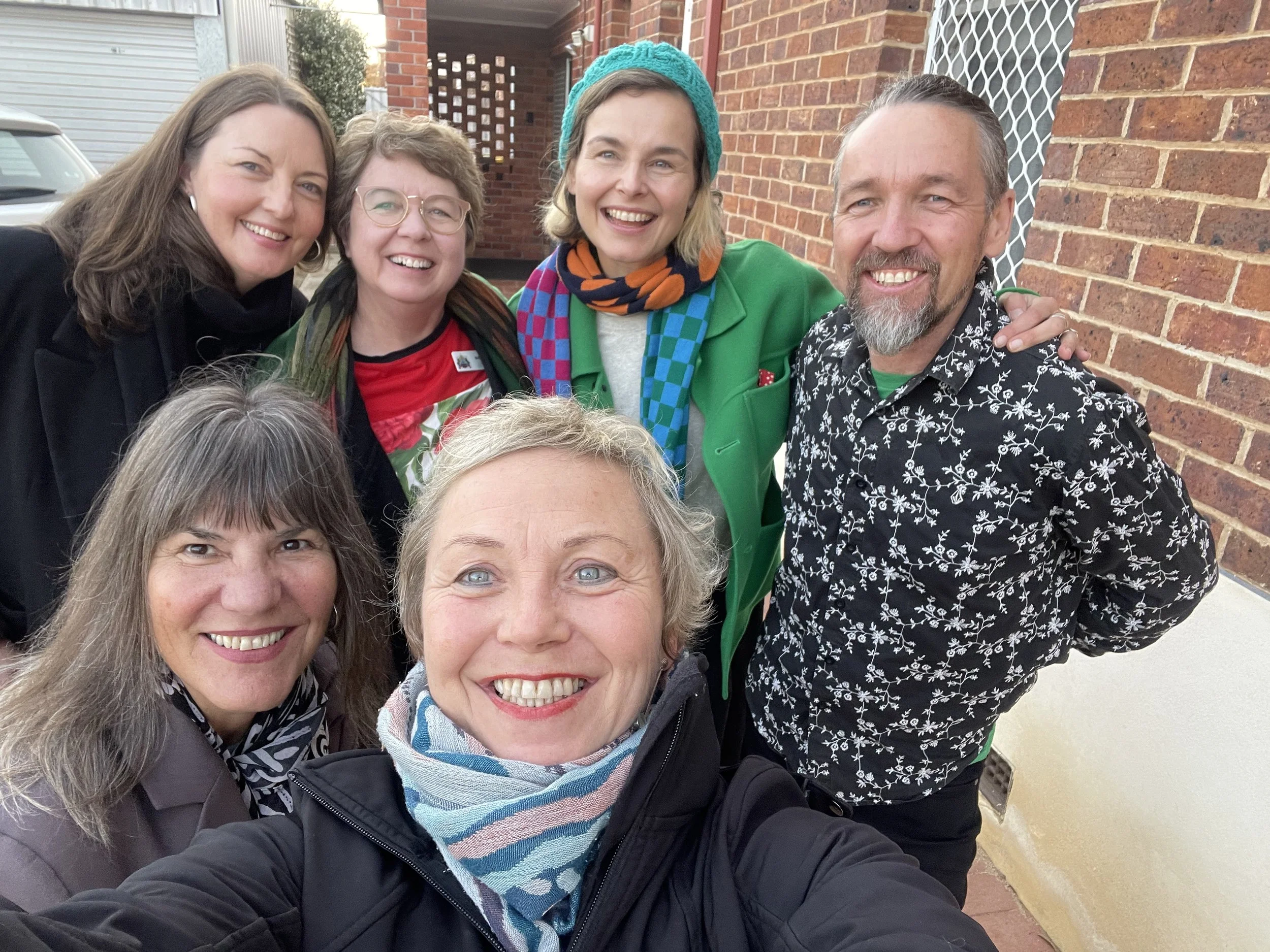
The Katanning Panel team: Top L to R: Meri Fatin, Lynn McLaren, Riley Salmon-Lomas and Peter Hill. Bottom Line to R: Mags Webster and Tineke Van der Eecken, Katanning, September 2024. Photo Tineke Van der Eecken
Back in September ART ON THE MOVE facilitated the Arts & The Environment Panel Discussion which coincided with the opening of Tributaries by Tineke Van der Eecken at Katanning Library & Gallery.
ART ON THE MOVE: In this conversation, hear facilitator Meri Fatin, artist Tineke Van der Eecken, poet and writer Mags Webster, councillor Lynn MacLaren, artist Peter Hill, and audience members, discuss Western Australia’s natural environment, the urgency of caring for the land and the non-human world, and how this informs their work. They explore ideas of place and belonging, the cycle of life and death, language and poetry, and the artists that inspire them.
The recording is available in full here on the ART ON THE MOVE website.
PANEL DISCUSSION AT THE OPENING OF TRIBUTARIES BY TINEKE VAN DER EECKEN AT KATANNING ART GALLERY, 10 SEPT 2024
EXCERPT FEATURING MAGS WEBSTER
Meri Fatin: (…) Mags, you come to this from a different perspective all together, not from the perspective of an activist at all. In fact, you're a PhD in creative writing, and you are a writer and researcher and published poet, as I said. Tell me how you've come to this conversation, because you've got quite a good working relationship with Tineke, haven't you?
Mags Webster: Tineke and I met many years ago through writing, and I was aware of her practice as a maker as well. She invited me to be part of an opening performance at
one of her exhibitions many years ago, which was…
Tineke Van der Eecken: 20 years ago.
Mags Webster: Gosh. Yeah, okay. 20 years ago, yeah, absolutely. So, we've known each other over this period of time, and I've been aware of the work that she's been
doing, but not following it very closely, and then I was absolutely delighted when she approached me to write the catalogue essay for Concurrencies, which is the next
exhibition on from Tributaries, and focuses on the marine animals that she made corrosion castings from. So, for me, as a writer, it's always a wonderful opportunity to be able to spend time with artworks and really focusing in on the detail and being very attentive to the stories that they might represent.
I think with the corrosion castings, the thing that really intrigues me, and this is perhaps connected to what I do as a writer, is these castings are showing the real interiority of a creature, of a being. They're also showing us our own interiority. When making a poem, in a sense, that's where I'm going as well, and then it becomes externalized. So, sometimes when I look at the horse head with the vascular structures adorning it, I think of, yeah, that's a bit like a poem. We eviscerate ourselves and wear
the lines on ourselves. And, of course, it's for everybody who reads a poem to derive whatever meaning they want to derive from it. It's not the poets say so, the poems belong to all of the readers, but it's an offering in the same way it can be an exposure. And so, I'm not an activist in any sense, but I guess, I'm an ordinary person who is fascinated by what people are doing. The lengths that the, the arguments, and the passion and the complete rightness of what people like my friends along the table are
achieving. And then some people will be in the thick of it, and some people will probably be stepping back and observing. Maybe I'm one of those, but maybe there's a benefit to that in the sense of a witness to what's going on, and as a communicator as well.
Meri Fatin: I love that and I wanted to ask you just a little bit further on where you see yourself sitting on that spectrum, because you've said quite clearly that you're not an activist, but that you do care. So, what is it that holds you back then from maybe you might call yourself an advocate rather than an activist or maybe not even that? Because I think it's really interesting, everyone is useful on that spectrum. I think we can't all be heavy on the activist end or the opposite end, we have to scatter evenly
across to be useful. But just because you said quite clearly that you are not, I'm just interested in that.
Mags Webster: Look, it's a hard question to answer. Temperamentally, I'm under the radar. I work in other ways. I don't know whether that's an adequate answer. There are
things I can do in other ways.
Meri Fatin: Yes. So, in regard to poetry then I would love to hear you talk about why you find, because we know from Concurrencies, which I have here somewhere as well, that you write prose as well. But why is poetry your favorite medium?
Mags Webster: Because it's a challenge, but also because I realized that when I started getting into, I used to write short stories and short fiction, and then I realized that
because I had some really inspiring mentors that my stories are getting shorter and shorter. I was becoming more and more focused on the language, and the rhythm, and
the fascination. There was a fascination between being able to express something that in some ways was inexpressible, and could I do that as a writer? And it seemed to me that I was going back into an education, starting a complete education in language and poetry all over again. Relearning a different way of speaking, a different way of reading the world. I think being able to work with language in a much more intimate way and intimate sense, I think that was what was happening for me with poetry.
Tineke Van der Eecken: Can I pick up on that? I love what Mags does in expanding something that you make in art to another language, a written language that is
investigating, researching and exploring, and beautifully bringing that again into form. I often feel like I don't have enough languages to explain what I'm seeing, so I use
poetry as well to take something that even further. And maybe there's some point, I can read a bit of the poem there.
Meri Fatin: Please. I was going to invite you both, so please, if you feel you'd like to.
Tineke Van der Eecken: Perhaps you could hold up the image of the, next to the, yeah.
So, in Tributaries here, and you can find this poem in the catalog. There's a poem that really takes this exhibition, the visuals from that in my mind away from the waterways here and into waterways more globally. Because we are connected, we are connected with the...so, Tributum, which is Tribute.
"Tributum, a statement of gratitude. How a river flows into a greater water, lake, sea.
How the worth of one pays the other. We are waterways.
Our blood connects with the Aral sea, salt deserts, where ancestors fished.
A shrinking womb split into three lakes, climate no longer moderated by sea.
Lake Chad inland seas dry up, shore retreats from Nigeria and Niger.
Fish farmers move with the lake, leave irrigation plants dry.
We are waterways. Our veins swallow the breathing wetlands."
Maybe you can read the rest of the poem at your ease, but it's taking it further, which is what text can do, and that's why I was-
Meri Fatin: Yes. And reading, Mags, I know that we can't share it at the moment, reading Mags’ essay in Concurrencies is exquisite. It's really exquisite.
Mags Webster: Thank you.
Meri Fatin: Would you like to read and tell us about your poem and read, or would you like to speak to your slides first?
Mags Webster: Shall I get the slides done? Okay. So, I've chosen this image. All of the images that I've chosen, I realize are by artists and writers who are now deceased, and
that wasn't intentional.
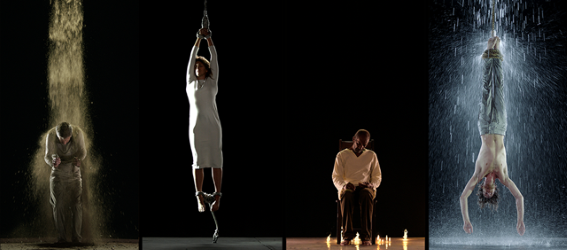
Bill Viola, Martyrs (Earth, Air, Fire, Water), 2014, photo by Kira Perov
Bill Viola was a wonderful video artist who died a little bit earlier this year. He's from the States. This video installation I first came across, I went to St. Paul's Cathedral when I
was on a visit back to London and this was one of the installations there. There was a particular reason why it should be in a place of worship, partly because a
place of worship like that has the scale that something like this, this is huge. It is really, really big. But also the theme of it, Martyrs (Earth, Air, Fire, Water).
So, you can see, unfortunately, the guy with the earth coming down him is a little bit obscured. But you can see that these figures are all undergoing an ordeal of one
element or another. And over the period of the video playing, you see the fire intensify, completely engulf the guy with the fire. The guy who's inundated with water, the woman who's suspended, and she's in wind. You can see the action of the wind really working on her. And this person at the end just gets completely covered with earth. It really intensifies, and you can't look away, because it's pretty full on, and then it reverses and everything becomes quiet again. Everyone's interpretation is likely to be different when watching something like this, but for me, it was an intensely powerful spiritual artwork. Bill Viola tended to make artworks that would speak to some kind of Abrahamic story or biblical story. He was fascinated by poets such as John of the Cross who practiced via negativa, so negative theology. So, not talking about God in terms of God is this, God is that, but God is not this, God is not that. So, this negation, this stripping away, this acknowledgement of language, being unable to describe something that we don't know.For me, as a poet, that was this stripping away of language and this acknowledgement of language’s inadequacy in many ways to express and yet we still try because it's what we have. The parallels with the visual art there were really strong for me, and so this work's quite meaningful.
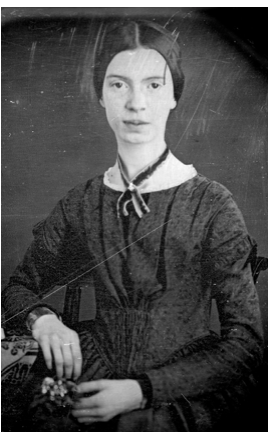
Image reputed to be of Emily Dickinson (1830 - 1866)
Emily Dickinson, American poet, she died when she was 56. She wrote thousands of tiny fragments of poems and none of them were published during her lifetime. They were discovered after she died. She'd put them into a drawer. She wrote them on scraps of envelope and paper, often in pencil, usually in pencil. For me, she's an enormous inspiration. I can't say that I understand her poetry, but there is something about an art form, and visual art can do this as well, when you have to keep going back to it, you have to keep going back to it because you're still working out what your relationship is with it, what it's showing you, what it might be saying to you.
And I find that Emily Dickinson's poems are very much like this, that they're showing me something different every time I go back. And she lived a very secluded life. She chose to withdraw from society and spent a lot of time in her bedroom, which was also her writing room. But she was incredibly connected to nature, and so many of her poems are constantly referencing a creature or the ocean or gardens or sounds. Those were her materials, basically nature was one of her materials and she worked with that, so really, really inspiring and very prescient poet as well.
Meri Fatin: When we were talking earlier, you said to me, I wrote it down, "Emily Dickinson will be perplexing me until I drop dead."
Mags Webster: Yeah, she will. Meri Fatin: Why?
Mags Webster: Because every time I think I may have decoded something that she's written, it slips away from me again. And so, I can't really say that I understand, but I can say that the attraction and the compulsion to try to unlock even a small part of her poems, and the way that she uses language, and she uses it in a very...I don't think anyone has since used language in the way that she managed to.
So, on a technical level, how does that happen? How does that happen? And then on an emotional and sort of poetic level, she's speaking to the biggest themes that we have as humans in life. And she even will write poems that sort of take you beyond the grave. They're spoken in the voice of a person who's already in the coffin, "Because I could not wait for death, he kindly stopped for me." I've probably not said, quoted that properly.
And the other thing that she says that I think is very interesting, not just in the poetic sense, but in a sense of how we all maybe operate from time to time, and she said, "Tell all the truth, but tell it slant." Very clever. Very clever.
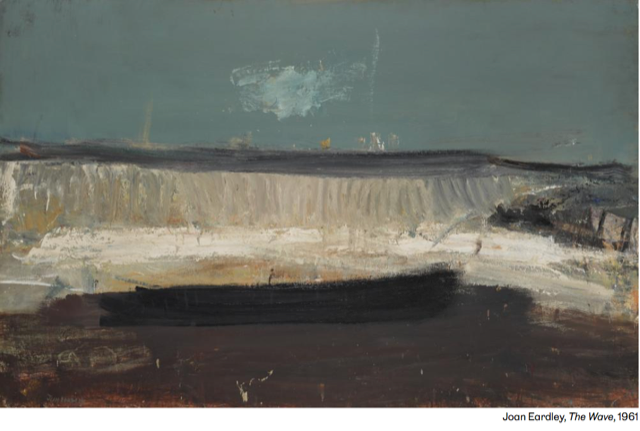
Joan Eardley, The Wave, 1961, National Galleries of Scotland
Meri Fatin: So, we've gone from video installation to poetry and finally your final slide.
Mags Webster: Yes, so this is The Wave by Joan Eardley, who was a Scottish artist. And sadly, I thinkshe made it into her 40s, but then had cancer and died in the 1960s. I mean, I could have chosen any one of her landscapes. It's passionate, it's savage, there's a lot of weather going on in this landscape. It's the north-eastern coast of Scotland and I lived in that area for a time, and the colors and the moodand the storminess, she really, really captures it and she was well known for this incredible work, that she saw this particular stretch of the coastline and could actually capture it in these really sort of powerful and strong paintings.
Meri Fatin: So beautiful, thank you, Mags. Mags Webster: Welcome.
Meri Fatin: And now your poem, speaking of...
Mags Webster: Yes, I would love to. I'm going to stand up because I get better breath control when I stand up.
Meri Fatin: So this is from one of your books published.
Mags Webster: This is from, yeah, one of my books, and I'm going to dedicate it to Tineke because it actually has an ocean theme to it and then I'm dedicating also to Concurrencies as an exhibition madefrom the ocean. And this poem is called Breathing Lessons.
I'm learning how to breathe. Underwater.
Life's harsh wish makes my corpuscles bloat,
blood strobes. The whole of an ocean holds me.
Down here, the reefs, a temple or a church filled with isles
of kelp, a slant with stained-glass shafts of sun, pale halos
of Medusae. Flocks of fish kiss digits of coral, fins steadying
for benediction.
I kneel to join the swaying congregations,
but they blanch, shiver into vanished blue.
The surface does not satisfy. I must deepen
though my lungs are in denial to the rationing of air.
Too long used to living inthe dry. An apprentice to these depths,
I cling to oxygen like clinging to God. My apparatus
rattles and tips. I gulp a supplicant,
my breaths blister upward, empty into light.
Is this why I've come so deep to learn, instead of oxygen, belief?
I unbuckle my weights, shrug from the grip of the skins.
Letting go of my mask is hard, but then
all the air I need rushes in.
Thank you.
Meri Fatin: Thank you, Mags.
The full transcript of the panel discussion can be found here.
Note: the poems quoted are taken from the transcription and therefore not displayed with the original line and stanza breaks.
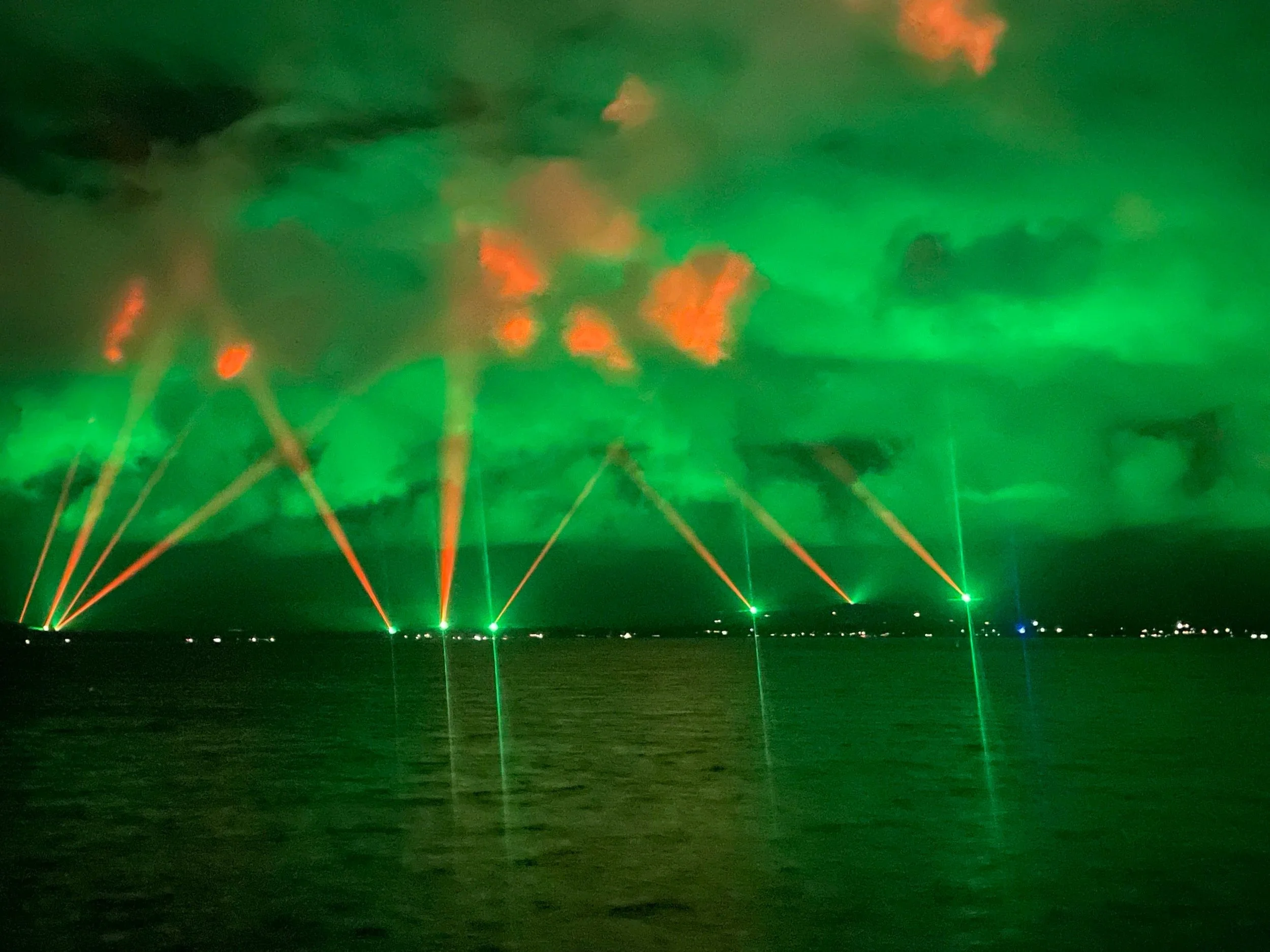
Lighting the Sound installation by Kari Kola and FORM, Albany, 14 March 2026. Photo Tineke Van der Eecken
UPDATE 17 MARCH
At our last lunch of ‘The Katanning Panel’ in October 2025, Mags spoke about her and FORM’s involvement in Lighting the Sound, a sensible and sensitive way of illuminating the bicentennial history of the city. Mags had seen the potential of working with light and connected Kari Kola with FORM, and their incredible team made it all happen in Albany. Light touches lightly. How else can you ‘celebrate’ two hundred years of occupation on unceded lands? Aptly, there had been a ‘First Lights’ arts event the weekend before to ground this in Menang history and storytelling, which we sadly missed but we did not want to miss Lighting the Sound because of Mags. So last weekend we drove the five hours there and back to witness this part of the events and pay a special private tribute to Mags. Meri Fatin was unable to make the trip and very sad to miss it but Riley, Lynn and myself sat down on a solid Albany rock to read Mags’ poetry and share stories of how we remember her. She stays with us through her writing and the moments we shared.
Goodbye, dear Mags.
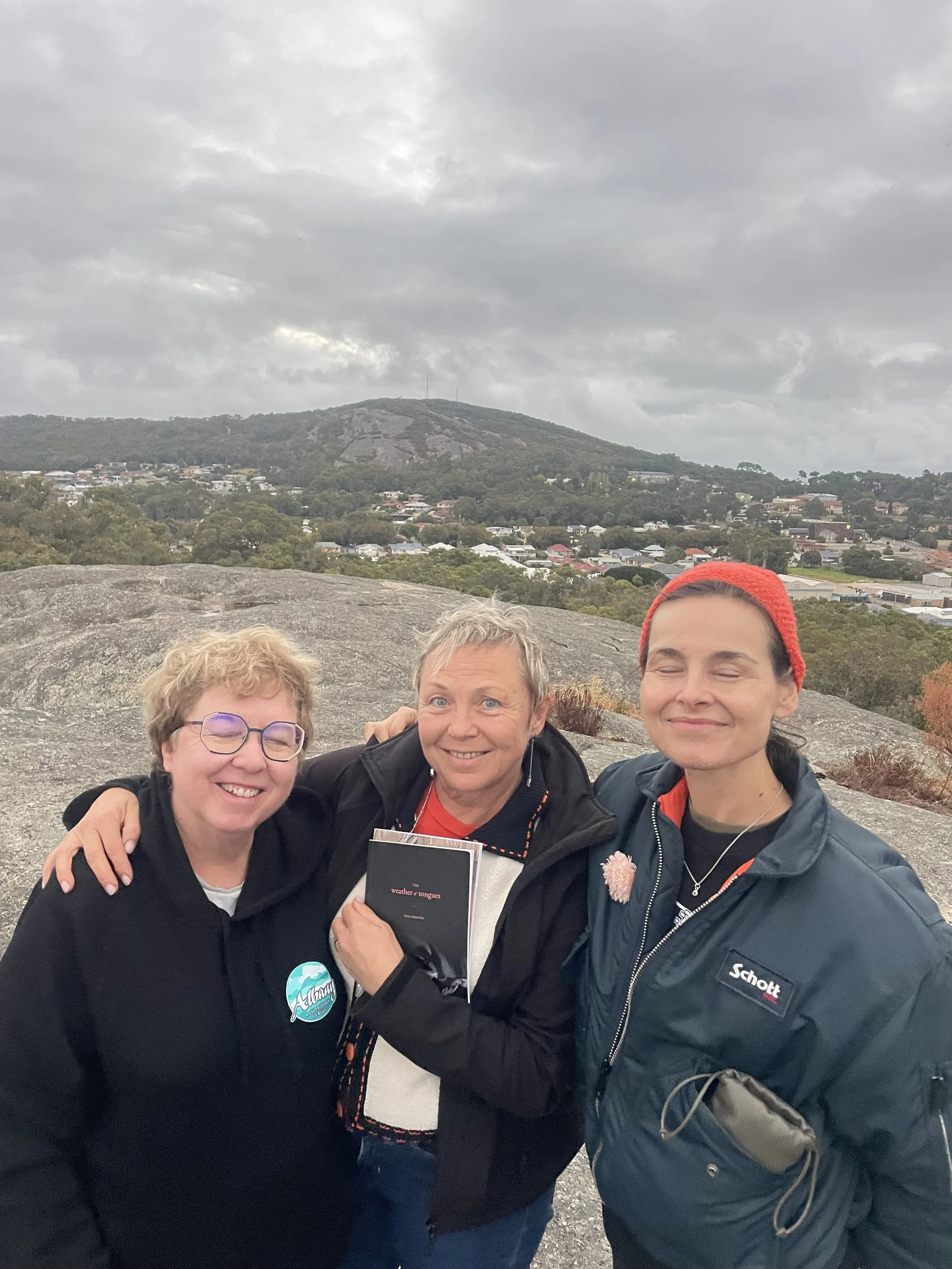
Lynn McLaren, myself (Tineke Van der Eecken), Riley Salmon-Lomas, Albany, 14 March 2026.